
There's No Single Price — It Depends on How You Get Help
Roadside assistance in Florida doesn't have one standard price because it isn't one service. What you pay depends on how you're getting help in the first place: a monthly auto club membership, a roadside add-on tacked onto your car insurance, or calling a mobile provider directly for the one job you actually need right now.
Each of those paths works on a different model. A membership or an insurance add-on is a recurring fee — monthly or annual — that you pay whether or not you ever need a tow or a tire change that year. In exchange, the plan typically caps what's covered: a certain number of calls per year, a mileage limit on towing distance, or exclusions on certain vehicle types. You only find out exactly what's included by reading the policy or membership terms, since plans vary by provider.
Calling a mobile provider directly, with no membership in place, flips that. You're not paying for coverage you might never use — you're paying for the actual job in front of you. The full cost shows up at once, on that one call, instead of being spread across a fee paid all year. For someone who rarely breaks down, that can work out to less money overall. For someone who's on the road constantly, a membership's flat fee can be the better bet. Neither is automatically cheaper — it depends on how often you'd actually use it.
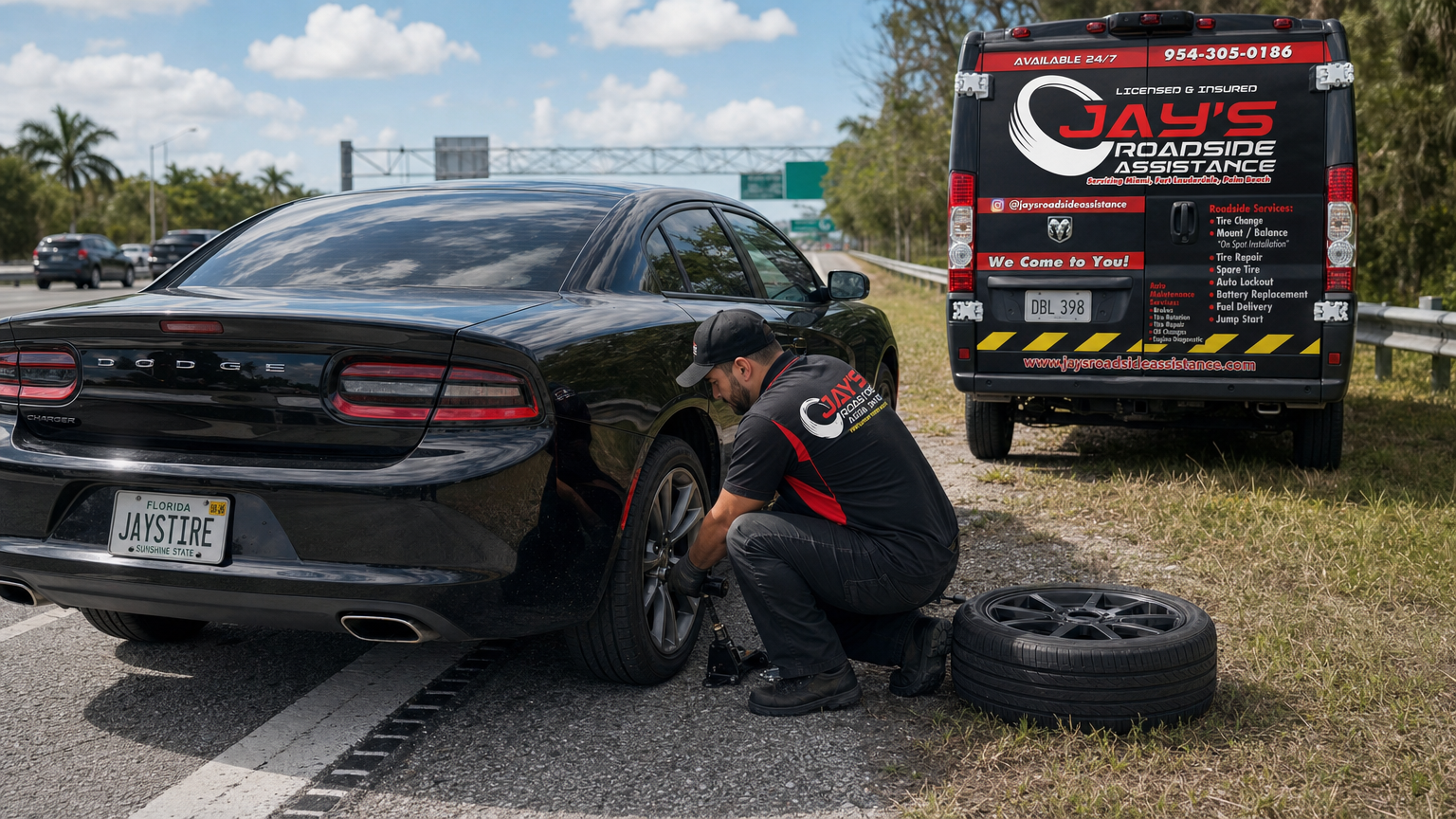
Picture a flat tire on I-95 during evening traffic. With an auto club membership, you call the club's dispatch number, they route the job to whichever contracted provider is available in their network that night, and the membership covers the call — but you don't choose who shows up or necessarily how long they take to get there. Call Jay's directly for the same flat, and you're speaking with the shop that's actually doing the work, agreeing on the job before anyone drives out. You pay for that one visit, but you know exactly who's coming.
What Actually Changes the Price of a Single Call
For a pay-per-call visit, a few things move the price: what's actually wrong with the vehicle, where you are when it happens, and when you're calling. A tire change at a quiet time of day costs differently than a late-night call dispatched from farther away.
The tire itself matters as much as the situation. A simple puncture on a standard passenger tire that can be patched is the fastest, most straightforward job. A tire that's damaged past repair and needs a full replacement adds the cost of the tire on top of the labor. Larger tires — on a pickup, a van, or anything running dual rear wheels — take longer to access, lift, and mount, and that shows up in the price too. A specialty or off-road tire is its own category again.
None of this is unique to Florida, but the state's highway mileage and traffic volume mean distance and timing come up constantly. A flat tire on the shoulder a few minutes from a technician is a different call than one much farther out, and a breakdown on a stretch of interstate late at night is a different job than the same flat near a busy intersection in the middle of the day.
Membership, Insurance, or Pay-Per-Call: Which Makes Sense
There's no universal right answer, but a couple of patterns hold up. If you drive a lot of miles, especially on unfamiliar roads, a membership or insurance add-on earns its keep just by being there every time you need it — you've already paid, so the cost question disappears the moment you break down. If you rarely have car trouble, paying a recurring fee for a service you might use once every few years rarely pencils out better than paying for the occasional job directly.
It also helps to know what you're actually comparing. An insurance roadside add-on usually routes you through your insurer's own dispatch service, which works much like an auto club — a call center assigns the job to a contracted provider in your area, and you don't always know in advance who that will be or how long they'll take. Calling a mobile provider directly cuts out that middle step: you're on the phone with the people doing the work, not a call center routing the job elsewhere. We've written in more detail about how that distinction plays out if you want to see it laid out side by side.
What Jay's Mobile Tire Shop Offers
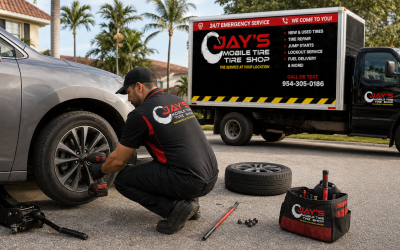
Jay's Mobile Tire Shop operates as a full-service mobile tire repair shop — the technician comes to the vehicle wherever it's stopped, rather than having it towed somewhere else first. That matters for cost because a mobile tire repair at the roadside can avoid the expense of a separate tow just to get the vehicle to a shop.
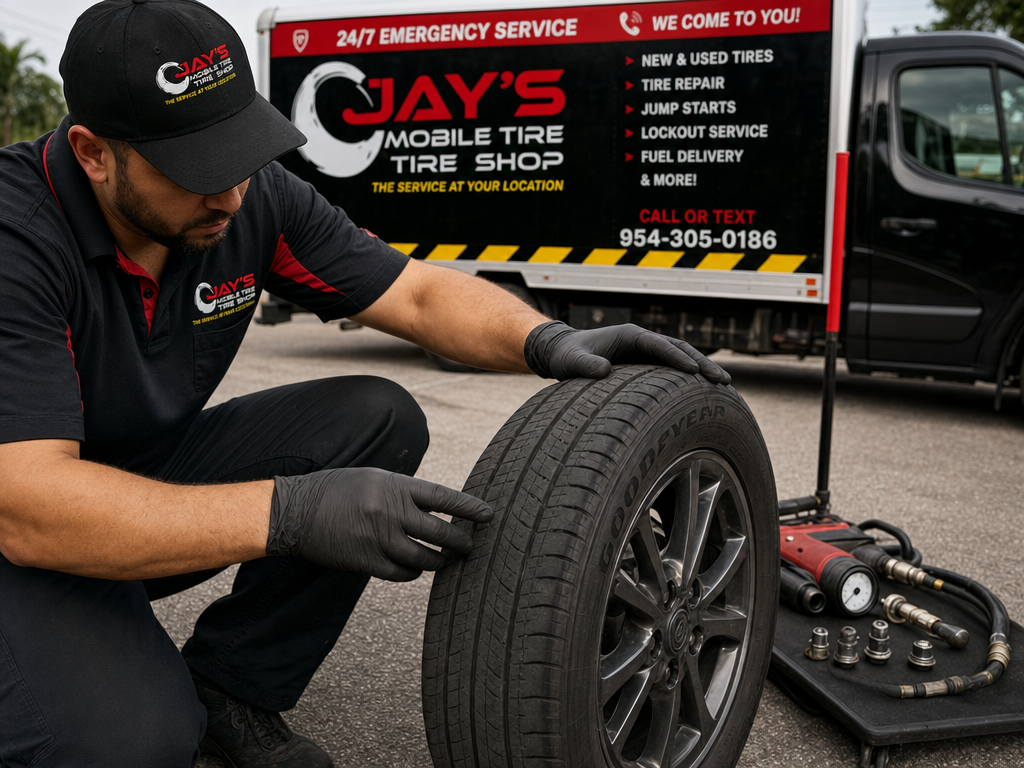
If you're in South Florida — including Aventura — the exact price for your situation depends on the tire, the location, and the timing, the same factors that apply anywhere. The only accurate way to know what a specific job will cost is to call and describe the situation before the technician is dispatched: the tire size, what's actually wrong with it, and where the vehicle is sitting.
While You Wait for Help
If you're stuck and waiting on a tire call, getting the vehicle and yourself safely out of traffic matters more than anything else in those first few minutes — before cost, before anything else. We've put together a short list of roadside emergency tips worth reading before you're ever in that situation, not during it. For a broader look at how mobile tire help works day to day, our Roadside Assistance page covers the rest.
Questions and answers
Does Jay's charge a flat rate or by the mile for a roadside tire call?
That depends on the specific job and location. The most reliable way to get an accurate number is to call ahead and describe the situation before the technician is dispatched, rather than relying on a general estimate.
Is mobile tire service cheaper than towing to a shop?
Generally speaking, a mobile tire repair can avoid the cost of a separate tow, since the technician comes to the vehicle instead of having it hauled elsewhere. Whether that works out cheaper overall depends on the specific repair needed and how far a tow would have been — it isn't a fixed rule.
Does my insurance's roadside coverage work with Jay's directly, or do I need to go through their dispatch?
That depends on your insurer's specific policy, which isn't something we can speak to on their behalf. If your plan requires using their dispatch network to be covered, calling Jay's directly would be an out-of-pocket job rather than a covered one. Check your policy or call your insurer to find out before deciding, especially if cost is the deciding factor.
If you need a real number for your situation, call Jay's Mobile Tire Shop and describe the job before a technician is dispatched — that's the only way to get an accurate quote rather than a general estimate.